How to check if a business name is trademarked (free guide)
A complete walkthrough of how to search the USPTO trademark database, interpret results, and know when to hire a lawyer. Free, in plain English.
Last updated April 29, 2026
Most founders pick a business name in an afternoon. Then they print business cards, register the LLC, build the website. A year later, an envelope arrives from a company they've never heard of, claiming the federal trademark on the name they've spent twelve months building a brand around.
It's avoidable. Thirty minutes on the USPTO database before you commit catches the most common conflicts before they cost you anything.
If you're forming an LLC, run the state Secretary of State search first using the LLC name availability check guide, then come back here to do the federal trademark layer. State and federal are independent and you need both.
The ten-minute version
If you only have ten minutes, do this:
- Open USPTO's trademark search tool at tmsearch.uspto.gov, the system that replaced TESS in 2023.
- Enter your name in the basic search.
- Look for any live registered or pending marks with the same or similar name.
- Live mark in your industry: pick a different name.
- Live mark in a totally different industry: probably okay, but get an attorney's read before committing.
- Nothing comes up: you've cleared the biggest risk. State databases and common-law usage still warrant a quick check.
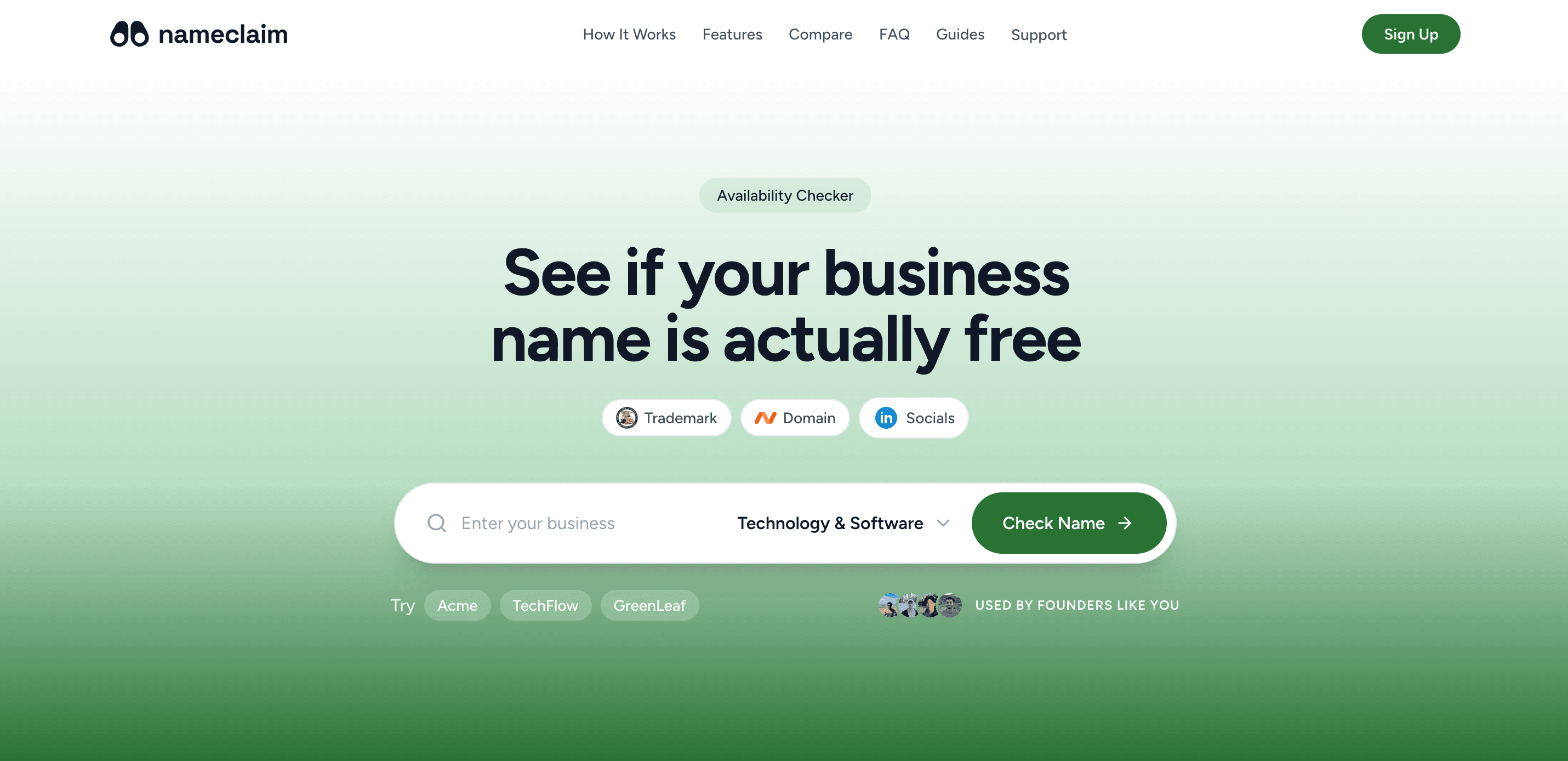
For a faster first pass that also covers domain and social handle availability, NameClaim runs the same USPTO query plus 18 TLDs and three social platforms in one search. It's not a substitute for a careful hand search, but it's a useful filter before you spend half an hour on a name that's clearly already taken.
Why this matters
A federal trademark gives the owner exclusive rights to use that name in commerce within their classified goods and services. Use a name that conflicts with one, and there are three outcomes you can expect.
The cleanest is a cease-and-desist letter forcing you to stop using the name. The worst is an infringement lawsuit, where damages run from a few thousand to several hundred thousand dollars. The most common is somewhere in between: a forced rebrand, which means a new domain, new branding, new collateral, and the SEO equity you built up over months gone with it.
The average cost of a small-business rebrand after a trademark conflict runs $15,000 to $50,000 once you account for legal fees, asset replacement, and lost momentum. A 30-minute search at the start prevents almost all of it.
This isn't theoretical. Startups have raised seven and eight figures and discovered post-launch that their name conflicted with a trademark nobody searched. Some rebrand. Others end up paying six figures to buy the conflicting trademark from the original owner.
Where trademark protection actually lives
Before you start searching, you need to know what you're searching against. There are four levels.
Federal trademarks are registered with USPTO and protect the owner nationwide within their classified goods and services. This is the level that creates most conflicts and the one you absolutely have to search.
State trademarks sit in state-level registries. Coverage is geographically limited (Massachusetts can't protect a name in Texas), but they still create conflicts in the states that matter to your business.
Common-law trademarks form whenever a business uses a name in commerce, even without filing anything. Coverage is limited to the geography where the business actually operates, but the rights are real and enforceable.
International trademarks live in country-level systems: EUIPO for the EU, IPO for the UK, CIPO for Canada. Each is its own search.
For most early-stage US businesses, a thorough USPTO search plus a Google search for common-law usage is enough. State and international searches become relevant once you start expanding.
How to actually search USPTO
The federal search is what 90% of founders need.
Step 1: Go to the USPTO search tool
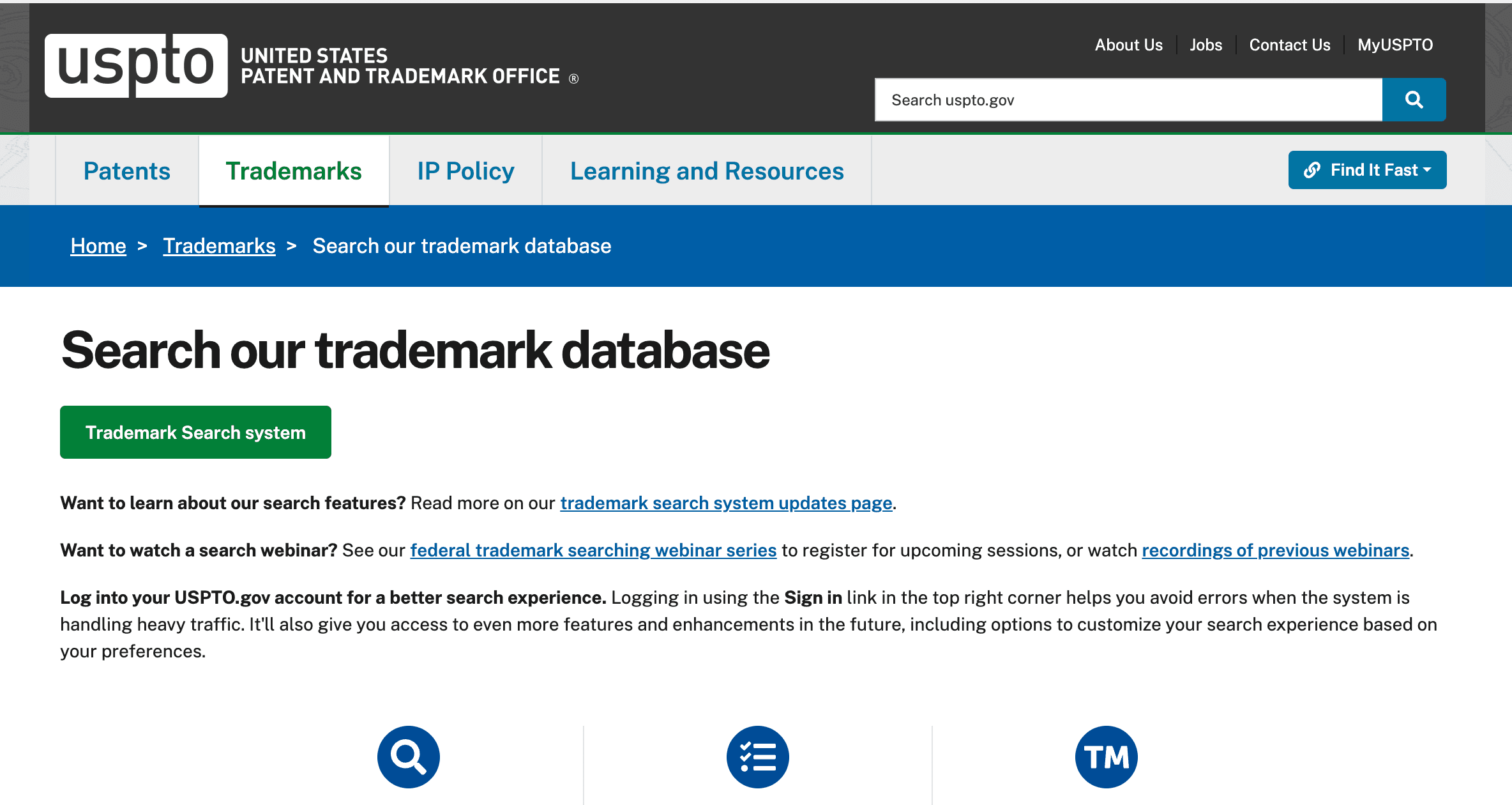
Open tmsearch.uspto.gov. USPTO retired the older TESS system in 2023 and replaced it with a less hostile (but still slow) interface. No account needed.
Step 2: Run a basic word mark search
Type your business name into the search box as a single phrase, with quotation marks for exact match. Without quotation marks, the system returns marks containing any of the words individually.
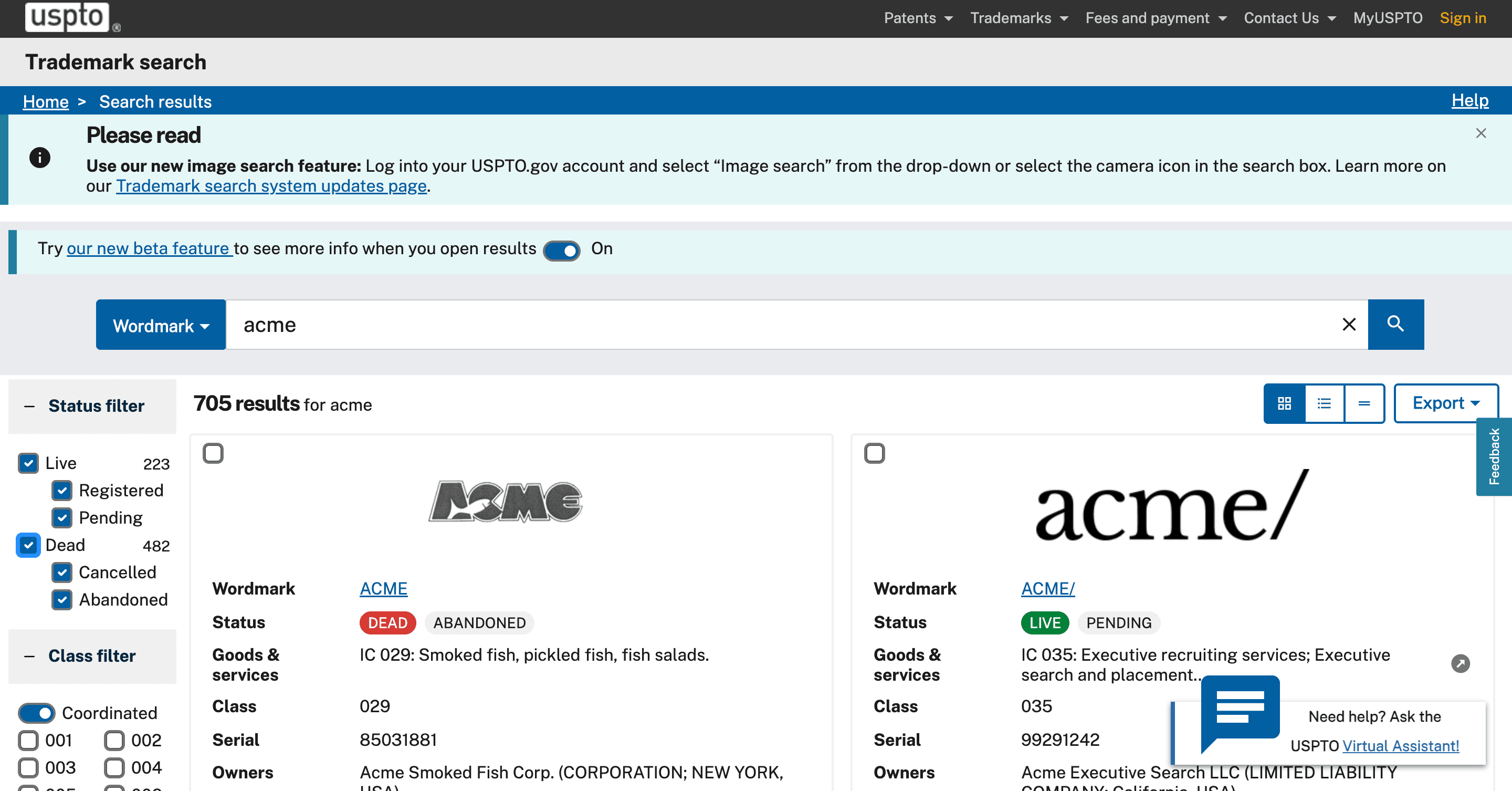
If your name is "Acme Solutions," start with "Acme Solutions". Then run separate searches for Acme alone (catches close variants), common phonetic variations like "Akme" or "Acme Sols," singular and plural forms, and obvious typos.
Step 3: Filter to live marks
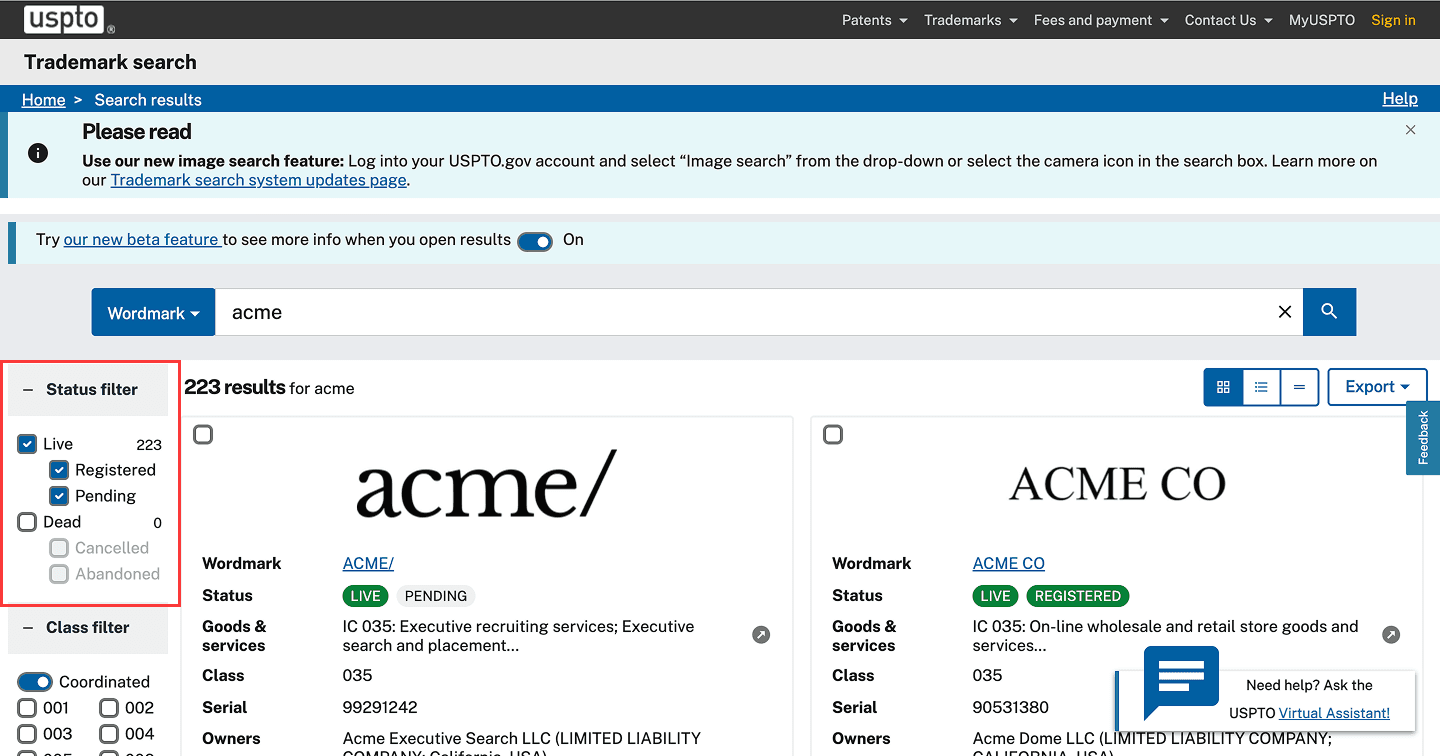
Each result has a status: live, pending, dead, or abandoned. Live and pending are the ones that can create real conflicts. Dead and abandoned marks usually aren't enforceable, but if a mark was recently abandoned, the original owner may still have common-law rights worth checking.
Step 4: Check the goods and services classes
Trademarks register against specific Nice Classification classes. There are 45 of them, covering everything from chemicals (class 1) to legal services (class 45). A trademark in one class doesn't always block a different business from using a similar name in an unrelated class.
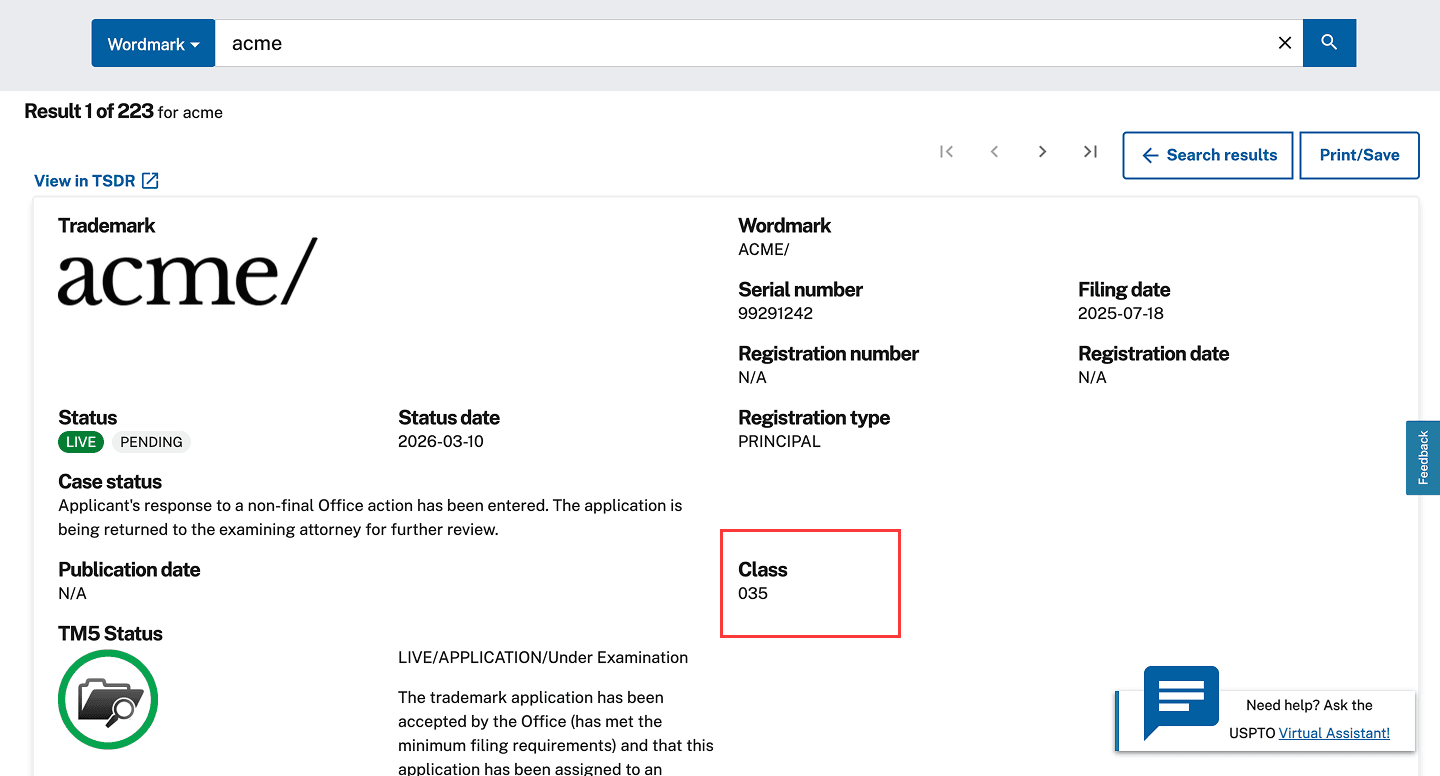
For each potential conflict, check what classes the mark is registered in, whether they overlap with what you'll do, and whether the goods and services description sounds similar to your business.
A clothing brand named "Acme" probably won't conflict with a software startup also named "Acme." But a tech consulting firm named "Acme" might conflict with a software product called "Acme."
Step 5: Check the owner and registration date
Look at who owns each potentially conflicting mark. Is this an active business? A quick Google search confirms whether they're still operating. A registered mark held by a defunct business is less likely to be enforced, though the owner can still send a cease-and-desist.
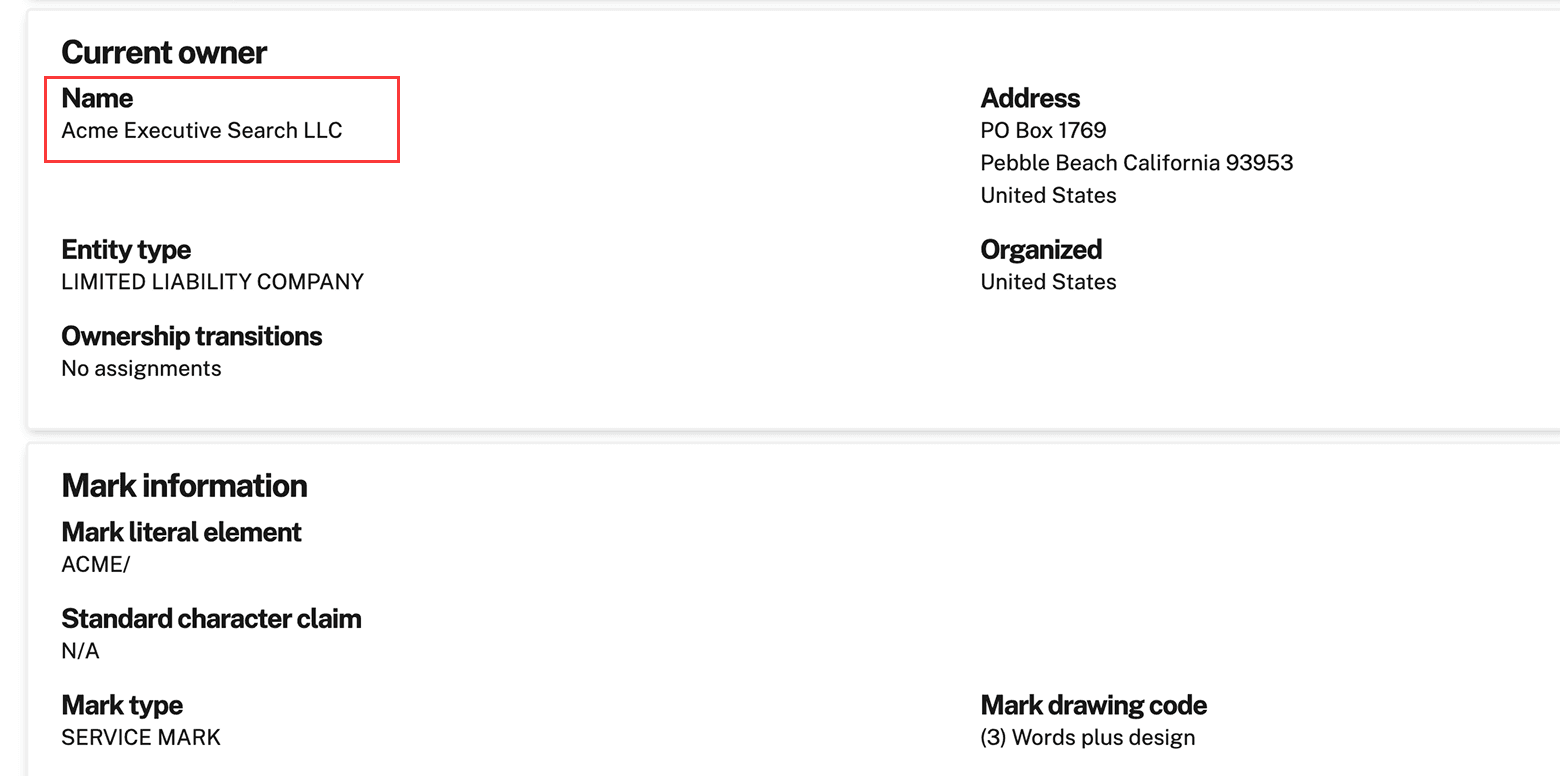
Registration date matters too. Older marks are harder to challenge. Something registered in 2008 has a stronger claim than something filed last quarter.
Step 6: Look for similar marks, not just identical ones
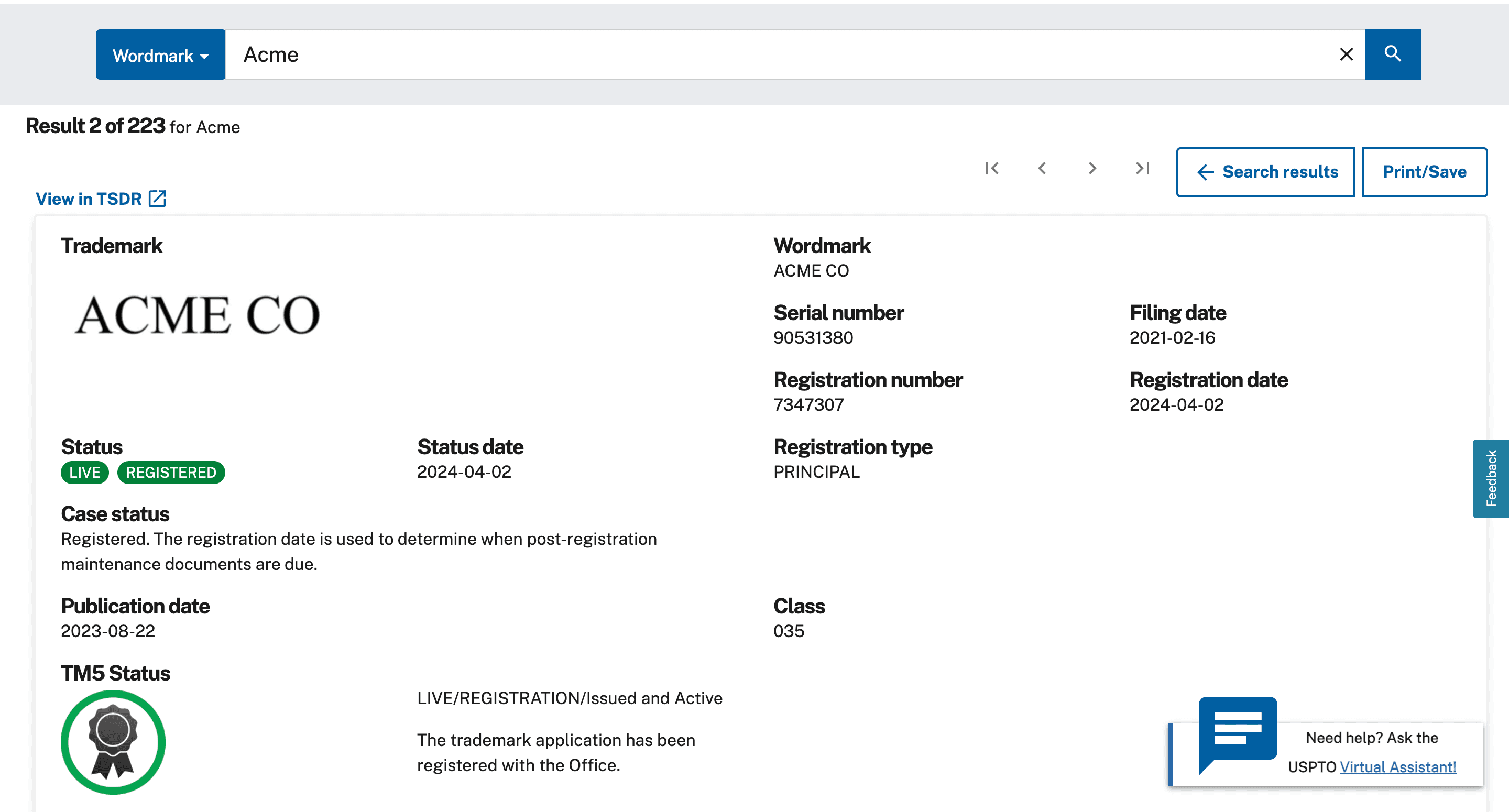
USPTO grants trademarks based on "confusingly similar," not just identical. Your search needs to include marks that are close to yours, not exact matches.
That means similar spellings (Acme, Akme, Aceme), similar sounds (Acme, Akmé), similar meanings (Acme, Apex, Pinnacle, where synonyms can conflict if they convey the same idea), and common prefixes or suffixes (Acme Labs, Acme Studios, Acme Co).
This is where DIY searching gets harder. It's the reason trademark attorneys exist. If your basic searches turn up close matches you can't confidently rule out, that's the signal to bring one in.
Reading your results
After running through the steps, you'll have one of three outcomes.
If you found no live or pending matches in your industry, you've cleared the most common risk. Now check whether the .com is available and whether the social handles are claimed. NameClaim runs all three in one shot if you want the fast version.
If you found live matches in different industries, it's usually okay, but the call gets fuzzy. Run the trademark by an attorney for a $200 to $400 clearance opinion before committing.
If you found live matches in your industry, or any pending application that resembles your name, pick a different name. The cost of a rebrand later is much higher than the inconvenience of finding another option now.
When the DIY version stops being enough
A trademark attorney brings two things you can't replicate yourself.
The first is a clearance opinion: a written assessment of whether your name is safe to use, accounting for similarity, classification, and common-law risks. Costs $300 to $1,500 depending on complexity.
The second is the actual filing. USPTO charges $250 to $350 per class. Attorney fees on top are usually $500 to $2,000.
Hire one if your DIY search turned up close matches you can't rule out, if you're investing real money in the brand (raising capital, hiring designers, building a product), if you plan to operate in multiple states or internationally, or if you're entering a crowded market where similar marks are likely.
For early-stage indie projects without funding, a thorough DIY search is usually enough to rule out the most common risks. For anything beyond that, the attorney pays for themselves the first time they catch a conflict you missed.
A faster first pass
USPTO's search tool is the authoritative source, but its UX is slow and the results take real time to interpret. For a first-pass check before you commit, NameClaim queries the USPTO database in real time and surfaces live and pending conflicts in seconds, alongside checks for domain availability and social media handles.
It doesn't replace a thorough hand search or an attorney's clearance opinion. But it's a useful 10-second filter for ruling out names that are obviously already taken, before you spend more time on something that won't work.
What happens next
If your search came back clean, three things are worth doing.
Check domain and social handle availability. A name with no trademark conflict is still useless if every related domain and handle is gone. NameClaim runs the one-shot check across .com, .io, .co, Instagram, TikTok, and LinkedIn.
Decide whether to file a trademark. Most early-stage businesses don't need to file immediately, since common-law trademark protection starts the moment you use the name in commerce. Filing matters once you've validated the business and want to lock in nationwide protection.
Document your usage. Save evidence of when you started using the name: first invoices, first social posts, first customer emails. This establishes your common-law rights even before you file anything formal.
If you found a conflict, the playbook is different.
Don't proceed. A federal trademark conflict is real, and continuing to use the name exposes you to legal liability.
Brainstorm alternatives. Sometimes a small variation works, like a different word or a slightly different industry framing. Run them through NameClaim to see what passes.
Talk to an attorney before you assume the worst. Some conflicts that look damning on paper turn out to be in unrelated industries with weak marks. A 30-minute attorney consultation costs less than the rebrand you'd otherwise be planning.
Picking a business name is unsexy work. It's also one of the few decisions in early-stage building you can't undo cheaply. Twenty minutes on USPTO costs you almost nothing. The rebrand you avoid costs $15,000 and up.